On our latest topic of 2026 trends, we've covered strategic ecosystems and AI integration. Now, let’s read about how 2026 events are abandoning rigid agendas for immersive experience design that transforms passive attendees into active participants and content co-creators. Research shows that active learners retain 93.5% of information compared to only 79% for passive learners, making participatory formats essential for achieving meaningful event impact.
The Death of the Lecture Hall
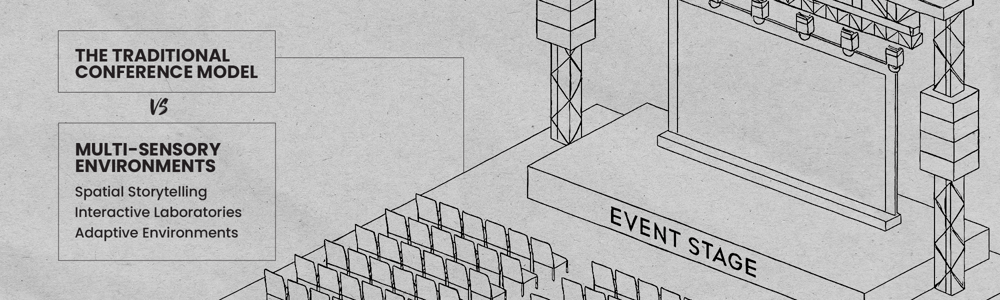
The traditional conference model—rows of chairs facing a single speaker—is rapidly becoming obsolete as organizers recognize that passive consumption leads to poor retention and minimal engagement. Modern attendees expect to be active participants, not just information recipients.
Traditional formats are giving way to dynamic, multi-sensory environments:
- Spatial storytelling: Physical spaces that guide attendees through narrative journeys
- Interactive laboratories: Hands-on exploration zones where attendees experiment with concepts
- Adaptive environments: Spaces that change configuration based on activity and energy levels
What Participatory Formats Look Like
The most innovative events break down barriers between speakers and audiences, creating intimate and collaborative experiences. These formats recognize that attendees bring valuable knowledge that can enhance everyone's experience through dialogue rather than one-way information transfer.
Three breakthrough formats:
- CEO talks without stages: Leaders embedded within attendee groups, fostering intimate dialogue and walking meetings
- Peer-to-peer dialogues: Structured networking beyond business cards, with problem-solving sessions where attendees share solutions
- Community-driven content: Attendee-generated session topics, collaborative workshops, user-generated permanent content
The Psychology Behind Engagement
Educational psychology research shows that active participation dramatically improves learning retention and satisfaction. When people physically engage through movement, discussion, or creation, their brains form stronger neural pathways that enhance memory formation.
Experience design leverages proven psychological principles:
- Active learning: People retain 90% of what they do vs. 10% of what they hear
- Ownership effect: When attendees contribute to content creation, they feel more invested in outcomes
- Dopamine rewards: Interactive elements trigger brain chemistry that enhances memory formation

Implementation Strategy
Creating engaging environments requires careful attention to sensory design, spatial configuration, and psychological flow. The most successful experiences layer multiple engagement methods to accommodate different learning styles while feeling natural rather than forced.
Your participatory roadmap:
- Start with journey mapping: Identify emotional peaks and valleys, design interventions for low-energy moments
- Test and iterate: Pilot formats with smaller groups, gather real-time feedback, document genuine vs. forced engagement
- Train your team: Develop facilitation skills, practice managing dynamic interactions, build comfort with improvisation
The Bottom Line
In 2026, the most memorable events won't feature the biggest speakers or flashiest technology. They'll be experiences where attendees leave feeling they contributed something meaningful and learned through active participation.
From our research to your strategic success, Rhiannon Andersen, CMO, Steelhead Productions